
The missing history behind a finished story
A published article may look like one coherent product, but its assets often pass through many hands and systems. A photograph arrives from a freelancer, is cropped by a picture editor, retouched by a designer, resized by a content-management system, compressed for a mobile page and distributed to partner platforms. A chart may be reconstructed from a spreadsheet.
Table of Contents
Digital provenance offers a way to preserve that history. It is a record of an asset’s origin and significant changes, linked to the asset in a way that can be checked. For publishers, it can help answer operational questions about source, editing, attribution, licensing and disclosure. It does not replace editorial judgment, copyright review or fact-checking.
The timing is important. The Coalition for Content Provenance and Authenticity (C2PA) provides version 2.5 of its Content Credentials specification [1]. In September 2026, the International Press Telecommunications Council (IPTC) highlighted a new framework for applying C2PA provenance across media workflows, from capture and ingest through packaging, publishing and distribution [2].
What Content Credentials can—and cannot—say
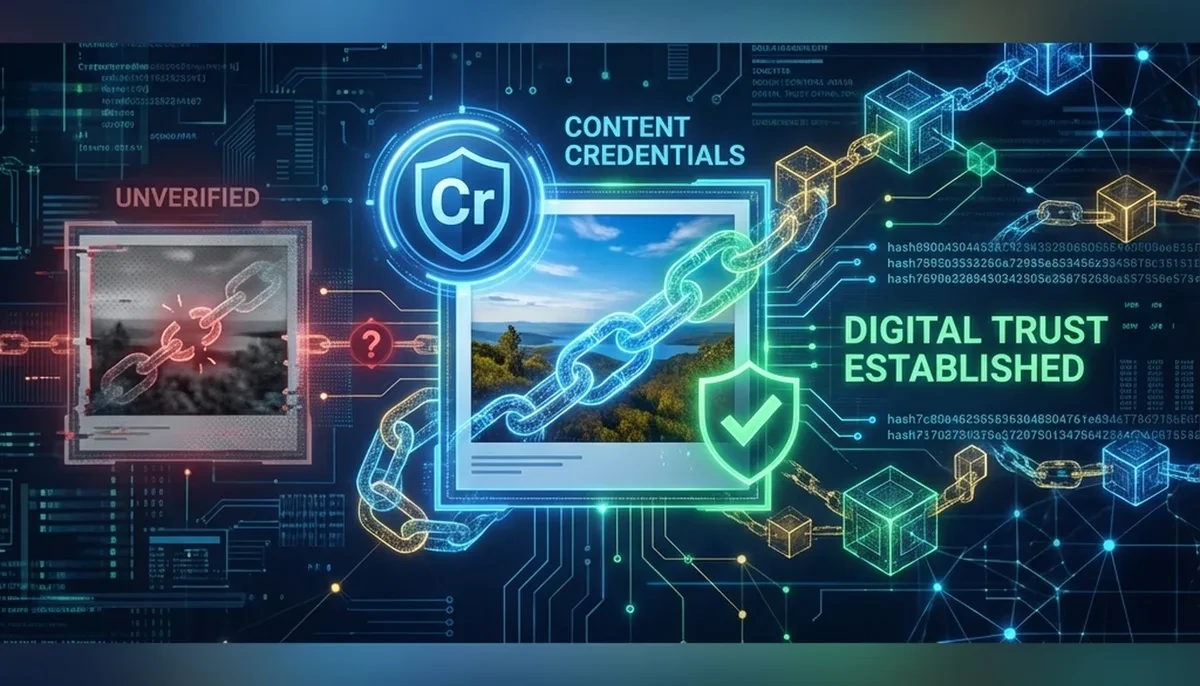
C2PA Content Credentials provide a technical structure for recording assertions about digital assets, including origin, actions and ingredients. The information is protected through cryptographic signatures and content binding, allowing a validator to assess whether the recorded claims remain associated with the asset and whether the manifest has been tampered with.
That distinction is essential. A valid credential does not prove that a photograph depicts what its caption claims, that an article is accurate, or that a person shown in an image gave permission. It indicates that specified provenance information can be validated under the relevant trust model.
Nor does missing metadata prove misconduct. Credentials may be absent because a camera, editing application or distribution platform does not support them; metadata may be stripped during a conversion; or a file may have passed through an older system. The correct response is to treat absence as a gap to investigate, not as proof that an asset is false.
Start with a publishing asset map
Before buying tools, map the journey of common asset types: photographs, illustrations, charts, video, audio, diagrams, tables and generated media. Record where each asset enters the organization, which systems store it, who may edit it, what derivative formats are created, and where it is published. Include external agencies, freelancers, syndication partners and localization vendors. Provenance is only useful when it follows the actual workflow.
Then identify the events that matter. A publisher may want to record creator and source, date of capture or delivery, rights and licence reference, consent status, editing actions, AI assistance, language adaptation, fact-check status and publication context. Not every event needs to be embedded in a file. Some may remain in a secure asset-management system and be linked through a stable identifier.
Separate descriptive metadata from provenance evidence. IPTC Photo Metadata provides widely used fields for administrative, descriptive and copyright information about images, supporting search, management and licensing [4]. C2PA addresses cryptographically verifiable records of origin and change. These approaches can complement one another: IPTC fields help people and systems understand an image, while Content Credentials can help verify the integrity of the declared history.
Build the workflow around five control points
First, capture and ingest. Preserve the original file as received and create a stable asset ID. Capture the contributor, source organization, delivery date, rights documentation and any available Content Credentials. Run a validation check at intake, but do not reject every file that lacks a credential. Route incomplete records to a human review queue and record why the asset was accepted.
Second, editorial review. When an editor crops, annotates, retouches, translates or combines material, record the change and its purpose. Where tools support C2PA, preserve or update the manifest so the new version carries an intelligible history. For tools that do not support credentials, capture the edit event in the digital asset management (DAM) or content-management system and associate it with the asset ID.
Third, rights and AI disclosure. Link the licence, permitted uses, attribution requirements, model-use restrictions and consent records to the asset. If generative AI contributed to an image or text, record the nature of that contribution in a policy-defined way. “AI used” is too vague for many workflows: a publisher may need to distinguish idea generation, background removal, translation, synthetic illustration and substantive image generation.
Fourth, packaging and distribution. Test which export formats and content-management processes preserve credentials and ordinary metadata. A file may lose metadata when resized, compressed, converted or uploaded to a third-party platform. Where credentials cannot travel with the published asset, retain a durable link or record in the publisher’s asset system, and consider a landing page or manifest-retrieval method for downstream users.
Fifth, archive and correction. Keep the original, approved master, publication derivative and relevant provenance record together. When a correction is made, create a new version and record what changed, who authorized it and which channels received the update. A provenance-aware archive makes it easier to answer later questions about a syndicated image, an outdated chart or a rights dispute.
A practical scenario: a multi-channel feature package
Consider an illustrative publishing team preparing a feature on coastal erosion. A photographer submits twelve images, a researcher supplies a map, and the design team creates an explanatory illustration. The article will appear on the website, in a print edition, in a newsletter and through two syndication partners.
At intake, each item receives an asset ID and its source and rights record are captured. The photographer’s original image files are preserved. A picture editor crops two images and records the action; a designer combines licensed map layers and creates a new graphic, linking the source layers and licence terms. The CMS stores the approved derivatives and links to their provenance records.
A week later, the researcher corrects a map boundary. The publisher creates a new graphic version, records the reason and approval, and updates the web page and newsletter asset. The original remains in the archive. If a partner asks which version it used, the team can identify the derivative and the correction history without searching through email.
Adoption without creating a metadata burden
Start with one asset class and one workflow—for example, commissioned photography in the digital newsroom. Define a small set of mandatory fields and events, assign an owner, and test the handoffs between contributor tools, DAM, CMS and distribution. Avoid asking editors to fill in dozens of fields that do not support a real decision. Automate collection where possible and make exceptions visible.
Agree on governance. Decide who can make provenance assertions, how organizational identities are represented, which credentials are trusted, how validation failures are handled and how long records are retained. Document what happens when an asset is supplied by a partner with a different standard. Standards adoption works best when editorial policy, contracts, technical implementation and partner agreements use the same vocabulary.
Measure outcomes that matter: percentage of assets with complete source and rights records; time needed to respond to a rights query; metadata loss across export paths; unresolved validation exceptions; correction propagation time; and the proportion of high-risk assets with a documented edit history. Do not measure success only by the number of credentials generated.
The strategic takeaway
Content provenance is most valuable when it is treated as a workflow capability, not a decorative label. C2PA offers a standards-based way to make some origin and change records verifiable; IPTC metadata helps publishers describe and manage assets; and the DAM or CMS connects those records to everyday editorial decisions.
Frequently Asked Questions
What is digital content provenance?
Digital provenance is a record of where an asset came from and how it was created, edited or transformed as it moved through a workflow.
What are C2PA Content Credentials?
They are a standards-based way to attach cryptographically verifiable provenance assertions to digital assets, including information about origin and changes.
Do Content Credentials prove that an image is real?
No. They can help verify the integrity and association of provenance claims, but they do not determine whether the image or its caption is factually true.
What if a file has no Content Credentials?
Absence is not proof of manipulation. The publisher should check its source and workflow records and treat missing provenance as an information gap.
How are IPTC metadata and C2PA different?
IPTC metadata structures descriptive, administrative and rights information. C2PA provides a mechanism for verifiable records about an asset’s origin and changes. They can be used together.
Do publishers need to replace their CMS or DAM?
Not necessarily. Many organizations can begin by adding validation, stable asset IDs, metadata fields and links to provenance records around existing systems.
References and Further Reading
1. C2PA, Content Credentials Technical Specification, version 2.5
2. IPTC, “IBC paper on provenance in media workflows released” (28 September 2026)
3. C2PA, Content Credentials Explainer, version 2.4, section on provenance and truth
4. IPTC, Photo Metadata Standard
5. IPTC, Photo Metadata User Guide
Related reading: explore how publishers can maintain structured content for digital product passports.